
The Marvel Method Explained: How Marvel Was Really Created

There is a version of Marvel history that has been repeated so often it can feel settled: Stan Lee at the typewriter, ideas flowing, artists translating those ideas into pictures. The reality of how many early Marvel comics were made was more complicated. Interviews, surviving original art and decades of testimony from the people involved describe a working system in which a substantial part of the storytelling could develop at the drawing board, before the final dialogue and captions existed. That system became known as the Marvel Method, and understanding it changes the way books by Jack Kirby, Steve Ditko, John Romita Sr. and Wally Wood are read today.
The point is not to replace one simplified legend with another. Lee was central to Marvel's voice, editorial direction and relationship with readers, while the artists often carried far more narrative responsibility than the word “artist” suggests. The interesting history lies in the interaction between those roles, and in the fact that the balance could change dramatically depending on who was drawing the book.

Examples from this period can be found throughout our Marvel Comics selection.
That distinction matters because sequential art is not simply illustration added after writing. Pacing, page turns, panel size, body language, expressions and the order in which information appears are all part of storytelling. The Marvel Method therefore blurred conventional distinctions between writer and artist, and it could operate very differently depending on the collaborators involved. With Kirby, visual plotting and expansion could dominate the process; with Ditko, later Spider-Man stories became increasingly artist-plotted; with Romita, the collaboration appears to have been smoother and more openly shared. That flexibility helps explain both the extraordinary creative energy of early Marvel and the arguments about credit that followed it.
By the early 1960s, Lee was overseeing and writing across a rapidly expanding line of titles, and producing full scripts for every page was increasingly impractical. An artist might receive a short plot, a loose premise or a discussion about the direction of an issue, then determine how the story unfolded visually: how many panels a scene required, where a confrontation accelerated, when a reveal landed and how one sequence connected to the next. Dialogue and captions could then be written over pages that already contained a substantial amount of narrative structure.
The Marvel Method is a collaborative way of producing comics in which the artist develops much of the visual narrative from a plot, broad story direction or conversation rather than from a complete panel-by-panel script. At Marvel in the 1960s, the exact balance varied considerably from title to title and from creator to creator, but the basic principle gave artists an unusually large role in shaping how stories were constructed. Stan Lee himself described giving artists the basic story and allowing them to work out the visual storytelling, while Jack Kirby, Steve Ditko and others later emphasized the extent of their own plotting and narrative contributions.
What Is the Marvel Method in Comics?
Jack Kirby: Building Marvel in Real Time

If one creator demonstrates the possibilities of the Marvel Method most clearly, it is Jack Kirby. His own recollections describe a process in which he frequently developed stories directly on the page, working out movement, escalation and resolution visually before Lee added the final dialogue. Surviving original art also preserves margin notes and written directions that show how much narrative information could already exist at the pencil stage. In that context, Kirby was not simply designing characters or illustrating somebody else's finished story; he was helping determine how the story moved.

Fantastic Four is where that process becomes especially visible. The series rarely feels like static illustration attached to a predetermined script. Ideas accumulate as the pages move forward, threats increase in scale and new concepts can arrive with extraordinary speed. Kirby's storytelling is physical: characters move through environments with weight, pages accelerate toward reveals and the universe often expands through composition before the dialogue explains what the reader is seeing. The Galactus trilogy is the obvious example because the arrival of the Silver Surfer and Galactus is established through scale, pacing and visual presence long before exposition can fully define what those figures mean.


Read across Fantastic Four, Thor and Kirby's other Marvel work, this helps explain why the description of Kirby as merely an illustrator has never been sufficient. He helped define the universe's sense of escalation, its cosmic dimension and the way stories could generate new characters and mythologies almost as a by-product of moving forward. At the same time, Lee's dialogue and editorial voice remained crucial to the finished books. The important point is not that one man did everything and the other did nothing, but that the narrative often emerged from a sequence of creative decisions that began with Kirby's visual construction and continued through Lee's verbal characterization.


That is the perspective behind our selection of Kirby-era Marvel books: the interest is not only in first appearances or famous covers, but in watching the Marvel Universe being constructed issue by issue.
Steve Ditko: Building Spider-Man from the Inside
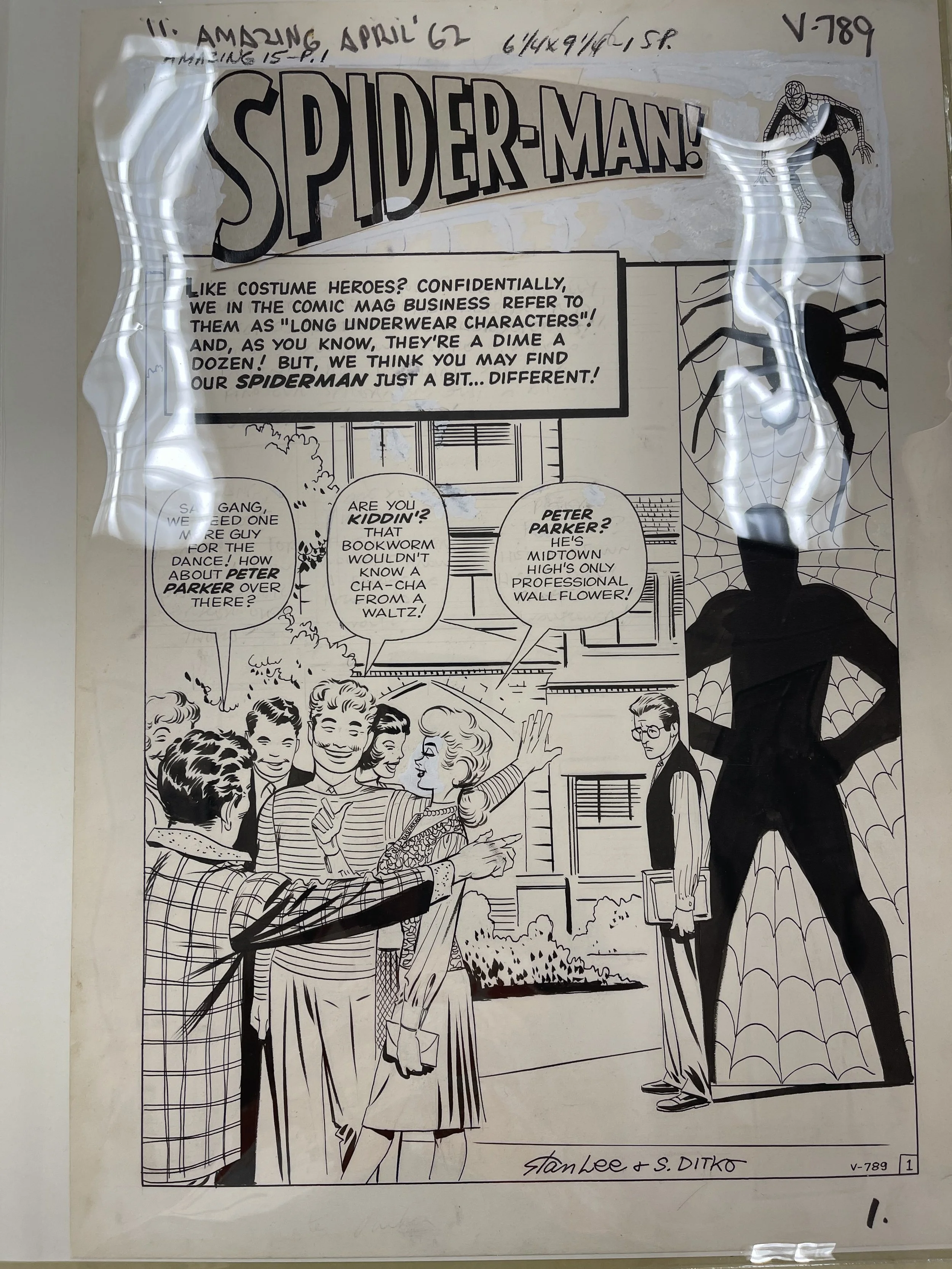
Steve Ditko used the same broad production system very differently. Where Kirby's pages tend to expand outward, Ditko's storytelling often compresses inward. His Amazing Spider-Man pages are tightly controlled, with movement and emotional pressure built through exact sequencing rather than sheer scale. Peter Parker's world feels crowded by consequences: school, money, secrecy, resentment and responsibility constantly press against the superhero plot, and the visual structure keeps those pressures connected. This is one reason Ditko's contribution is difficult to separate from the character's identity. The anxiety and introspection associated with Peter Parker are not conveyed only through dialogue; they are built into the rhythm of the pages.


As Ditko's run progressed, accounts of the collaboration indicate that he increasingly took responsibility for plotting complete issues before Lee supplied the dialogue. Whatever the exact balance on any individual story, the finished pages make his narrative control easy to see. The celebrated sequence in Amazing Spider-Man #33, with Spider-Man trapped beneath heavy machinery, works because of repetition, pacing and physical strain across successive panels. The words intensify the moment, but the dramatic architecture is already visible in the images.


The creative distance between Lee and Ditko also helps explain why the early Spider-Man period has such a distinct tone. Lee supplied much of the humor, verbal energy and direct relationship with the reader, while Ditko's pages carried a more private and often severe emotional logic. As their collaboration became more distant, those two sensibilities did not always point in the same direction. When Ditko left after Amazing Spider-Man #38, the title did not cease to be Spider-Man, but its atmosphere changed noticeably. Looking back at the run as a whole, it becomes clear that Ditko had not simply provided a visual surface for the character; he had helped establish the internal mechanics of Peter Parker's world.
Our Ditko-era Spider-Man selection is best understood in that context.
John Romita Sr.: A Different Spider-Man, Built with the Same Method

John Romita Sr. did not simply replace Ditko; he changed the emotional temperature of Amazing Spider-Man. His background in romance comics immediately opened the book visually. Faces, attraction, embarrassment and social tension became more prominent, and Peter's world began to feel less enclosed. The shift is especially visible in the growing importance of Gwen Stacy and Mary Jane Watson, where personal relationships become part of the book's narrative engine rather than a secondary layer beneath the superhero action.


Yet the underlying production system remained recognizably Marvel. Romita later described a fluid plotting process in which Lee might provide a direction, a villain or a basic situation, after which the artist worked out much of the pacing and visual structure. Romita also produced rough layouts before finished pages, making clear that narrative organization was taking place at the drawing stage. The difference from Ditko was therefore not that the artist suddenly stopped shaping the story; it was that Romita brought a different sensibility to the same basic mechanism.

That helps explain why the transition feels both dramatic and seamless. Spider-Man becomes more glamorous, social and romantic, while the storytelling still depends heavily on an artist who is organizing the narrative visually. Romita's relationship with Lee was also notably more comfortable than the strained endings of the Kirby and Ditko collaborations, demonstrating that the Marvel Method itself did not inevitably create conflict. Much depended on expectations, personalities, credit and how each creator understood the division of labor.

You can find examples from this period in our John Romita Sr. Marvel selection.
Wally Wood, Daredevil and the Question of Credit

Wally Wood's time at Marvel was brief, but it is especially revealing because he arrived with an established reputation from EC Comics and a strong sense of visual authorship. Daredevil was still finding its identity when Wood joined the title, and his influence was immediate. The most obvious legacy is the red costume introduced in Daredevil #7, but the change went beyond design. His pages are cleaner, more controlled and more confident in the way they direct the eye, giving the book a stronger visual identity at a moment when the character was still being defined.

Wood also worked within a system that expected artists to contribute to plotting, and his experience highlights the problem hidden inside that flexibility: a production method can distribute creative labor widely without distributing credit in the same way. Contemporary and later accounts differ on the details of Wood's frustrations and departure, but the broader tension is familiar from the period. When an artist is making decisions about story structure, pacing and visual development, the conventional distinction between “writer” and “artist” becomes increasingly difficult to maintain.


Wood left Marvel relatively quickly, but the version of Daredevil he helped shape proved durable. His short run is a useful reminder that the Marvel Method could generate extraordinary work precisely because it gave strong visual storytellers room to make decisions, while the same freedom could create disputes when the public language of authorship did not fully reflect the way the pages had been produced.
Stan Lee: Editor, Voice and System Builder

Once the contributions of Kirby, Ditko, Romita and Wood are taken seriously, Stan Lee's role becomes easier to describe without relying on the old image of a solitary author creating everything from the typewriter. His importance was different but still fundamental. Lee gave the line a recognizable verbal personality: conversational captions, humor, melodrama, direct addresses to readers and a sense that every title belonged to the same larger world. Through dialogue, letters pages and the Bullpen Bulletins, Marvel developed a relationship with its audience that felt unusually informal and continuous.
The Marvel Method itself was part necessity and part editorial system. Lee could not fully script an expanding line alone, so he relied on artists capable of carrying a large share of the narrative construction. His skill was partly in recognizing creators who could work that way and then giving the finished books a common voice when the pages returned. That does not settle every historical argument about who originated a particular idea or how credit should have been divided, but it explains why very different creators could produce books that still felt recognizably Marvel.
Seen from that perspective, Lee's strongest contribution was not that he personally constructed every plot point. It was that he helped create and maintain an environment in which a Kirby comic, a Ditko comic and a Romita comic could retain distinct visual personalities while still belonging to the same publishing universe. Marvel's identity came from that combination of strong individual creators and a strong editorial voice, not from either element alone.
Why the Marvel Method Still Matters
Understanding the Marvel Method changes the way these comics are read and collected because it shifts attention from credits alone to the construction of the page. A Kirby-era Fantastic Four is not interesting only because a character first appears or because a particular issue has become valuable. It preserves Kirby's approach to scale, pacing and visual invention. A Ditko Amazing Spider-Man carries a different kind of authorship in its tension, physical rhythm and emotional control, while Romita's pages show how radically a character's tone can change even when the underlying production method remains similar.
That perspective does not require choosing between “Stan Lee created Marvel” and “the artists created Marvel.” Both slogans flatten a collaborative history into something easier to repeat. The more revealing picture is a system in which dialogue, editing, plotting, design and sequential storytelling moved between people, sometimes smoothly and sometimes contentiously. The Marvel Method made that fluidity unusually visible because the finished script often came after major narrative decisions had already been made on the page.
At French Comics Lovers, that is part of what makes these books worth returning to. Collecting early Marvel can be about keys, condition and scarcity, but it can also be about seeing the medium develop in real time through creators who were actively defining how superhero comics could be told. Our curated Marvel comics include books from across that period, where the value of the object and the history of the storytelling are often inseparable.
What the Marvel Method Really Tells Us About Early Marvel
Looking back at these books, the most interesting conclusion is not that one creator secretly did everything. Marvel's identity emerged from a working process in which writing, drawing, plotting, editing and performance constantly crossed into one another. Stan Lee gave the line much of its voice and editorial coherence, while artists such as Jack Kirby, Steve Ditko, John Romita Sr. and Wally Wood frequently shaped the narrative directly on the page. Their contributions were different, sometimes complementary and sometimes contentious, but the comics exist because those contributions met.
The Marvel Method did not produce one simple answer to the question of authorship. It produced a body of comics in which the boundaries between writing and drawing were unusually fluid. Once you understand that process, early Marvel becomes more than a collection of famous characters, first appearances and key issues. You can see the universe being invented page by page, through the collision of several very different creative voices.
Sources & Further Reading
- Jack Kirby Interview — The Comics Journal — Kirby’s own account of his working relationship with Stan Lee and his role in constructing stories.
- Stan Lee Interview, 1968 — The Comics Journal — A contemporary interview in which Lee discusses giving artists broad story ideas and working from completed pages.
- Stan Lee — National Endowment for the Arts — Lee describes the Marvel Method and the creative role of artists such as Jack Kirby.
- John Romita Sr. Interview — The Comics Journal — Romita discusses plotting, visual storytelling and his collaborative relationship with Lee.
- The Ditko Version — Comic Book Historians — A study of Steve Ditko’s recollections of his increasingly independent plotting work at Marvel.
- Wally Wood — The Comics Journal — Historical material on Wood’s work, storytelling role and frustrations with the Marvel production system.
- Jack Kirby Museum — Margin Notes — Examination of surviving original art and Kirby’s margin notes as evidence of the storytelling process.